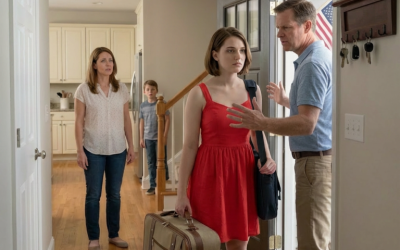


“But why didn’t you tell us? If you had that kind of money, we could have helped manage it. Invest it. Protected you.”
“Protected me?” I said. “The way you protected me by deciding where I should live?”
He tried other angles after that—business logic, scheduling problems, employee obligations, the burden of expectation. I answered each one the same way.
“No one is asking you to drop everything. I’m asking you to make your mother a priority while she is still alive.”
Then he made the mistake of saying it.
“But you chose to live here.”
I stood so slowly the room seemed to quiet around me.
“I chose nothing, Michael. You and your sisters decided I was too much trouble and arranged my life accordingly.”
His shoulders sagged.
“Mom, I’m sorry. I really am. But this is such an extreme response.”
“What would have been an appropriate response to being abandoned by my own children?”
He had no answer.
We might have ended there, with grief and stalemate, if Sarah had not stormed into the conference room like weather.
“Cut the act,” she said, slamming her briefcase on the table. “We know what you’re doing.”
“Do you?”
“This is manipulation. Abuse of power. Financial coercion.”
“What law have I broken, counselor?”
She stared at me, furious because she knew the answer.
Then she pulled out a thick folder.
“I hired a private investigator.”
That, I admit, impressed me.
She spread bank records, property documents, and correspondence across the table.
“You planned this,” she said. “You were talking to Bradford and Associates before we moved you in.”
“That was for estate planning,” I said evenly. “Catherine had just died. I needed legal advice. The idea to buy this place came after you left me here.”
Sarah’s eyes flashed.
“You expect me to believe that?”
“What exactly are you accusing me of? Having foresight? Having money? Having enough backbone not to disappear quietly?”
Then she did something crueler than the folder.
She pulled out her phone.
“James found something else,” she said. “Something from Aunt Catherine.”
My stomach tightened.
She pressed play.
Catherine’s voice filled the room—fainter than I remembered, but unmistakably hers.
“Ellie, if you’re hearing this, it means I’m gone and you’ve learned about the inheritance. Those children of yours are going to leave you somewhere to fade while they continue their selfish lives. Don’t let them. Use this money to turn the tables. Show them what it feels like when someone else holds the power.”
I sat very still.
The recording ended.
Michael looked stricken.
“Mom… is that true? Did Aunt Catherine know? Did you know before we told you?”
I closed my eyes for just a moment.
“Catherine saw the signs,” I said quietly. “She knew the direction things were heading. I hoped she was wrong. Up until the day you arrived at my house, I hoped she was wrong.”
“But she wasn’t,” Jessica said from the doorway.
We had not heard her come in.
She looked wrecked—red eyes, trembling hands, tissue box clutched to her chest.
“She wasn’t wrong,” Jessica said again. “We did exactly what Aunt Catherine said we would do.”
Sarah shot her a warning glance.
But Jessica had crossed some internal line and was no longer interested in defending any of us.
“I didn’t sleep last night,” she said. “I kept thinking about what we did. We disposed of you. And the worst part is that even now, even after finding out you own this place, my first instinct was still damage control. Not remorse. Not love. Strategy.”
Her honesty altered the air in the room.
For the first time, all of us were standing in the same truth.
“What kind of people have we become?” she whispered.
I reached for her hand.
“You became busy adults,” I said. “You became people who confused success with permission. You became what I taught you to become in some ways. Independent. Driven. Focused on your own lives. I just never imagined that would leave no room for me.”
Sarah gathered herself first.
“So what happens now?”
“You choose,” I said. “You decide what kind of children you want to be to your mother for whatever years I have left. The policy stays. Families who visit less than twice a week remain restricted. Those are the rules.”
“This is blackmail,” Sarah snapped.
“No. This is consequence.”
Michael asked the question that told me he still had one eye on the ledger.
“What about the money? What happens to the inheritance now?”
“The money is mine,” I said. “It will be used to improve this place and the other facilities. It will be used so that people here live with dignity.”
Jessica looked up at me, tears still sliding down her face.
“Do you still love us?”
That question hurt more than the legal threats, more than the recording, more than the folder.
“Yes,” I said. “I still love you. That is exactly why this hurt so much.”
They left together that day, subdued and raw.
For three weeks, I heard nothing.
Keine Besuche. Keine Anrufe. Keine hektischen Verhandlungen. Stille legte sich wieder um mich, aber es war nicht die Stille der ersten Wochen in Sunny Meadows. Es war die Stille von Menschen, die gezwungen waren, sich mit sich selbst auseinanderzusetzen.
In dieser Stille begann sich die Einrichtung auf eine Weise zu verändern, die befriedigender war als Rache.
Die Handwerker renovierten den Ostflügel. Warmes Licht ersetzte das grelle, summende Neonlicht. Die Wände wurden in sanften Blaugrüntönen gestrichen, die beruhigend wirken. Der Teppichboden wurde durch einen saubereren, robusteren Bodenbelag ersetzt. Wir stellten zwölf neue Pflegehelfer, vier examinierte Krankenschwestern, zusätzliches Reinigungspersonal und mehr Küchenpersonal ein. Notrufe wurden schneller beantwortet. Die Bewohner mussten weniger warten. Das Gebäude wirkte deutlich entspannter.
Die vollständige Kochanleitung finden Sie auf der nächsten Seite oder durch Klicken auf die Schaltfläche „Öffnen“ (>). Vergessen Sie nicht, den Beitrag mit Ihren Freunden auf Facebook zu teilen.