
Because some forms of respect are counterfeit, yes, but even counterfeit money can buy you a little room to breathe. Besides, the only opinions that truly matter have already declared themselves. Marco cannot stop touching your shoulder as if checking you are still there. Lara keeps catching your eye from across the room and smiling like a daughter trying to reassure a mother, not the other way around.
And then there is Elena.
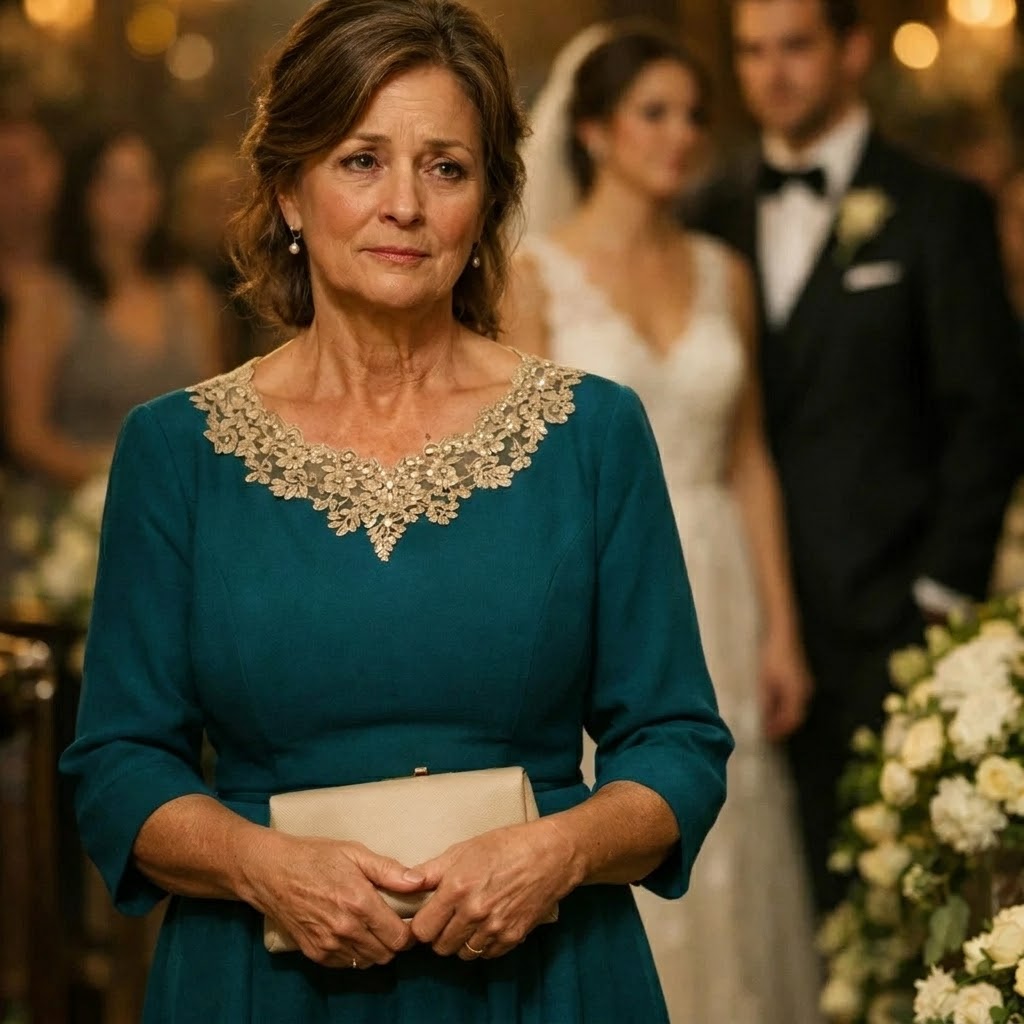
She approaches you while waiters glide past with trays of champagne and tiny pastry shells you do not know how to eat without looking foolish. Up close, she smells faintly of jasmine and expensive powder. For months you have assumed that if Lara respected you, it was in spite of her mother, not because of anything in that family’s example. Elena always greeted you courteously, but there was distance in it. Not rudeness exactly. More like a woman being very careful not to catch another woman’s life on the hem of her own.
Now she stops in front of you and lowers her voice.
“Teresa,” she says. “May we talk?”
You nod.
She leads you away from the center of the hall to a quiet corner near a wall of ivy and hanging lights. For a moment, neither of you speaks. The music is soft behind you. Guests are laughing. Glasses clink. Somewhere, a child shrieks with happiness and is immediately hushed by two adults at once.
Then Elena surprises you.
“I owe you an apology.”
You look at her steadily.
Her hands tighten around her clutch. “When Lara first told us about Marco’s background, I judged things I should never have judged. I thought about status, appearances, what our friends would say, whether they would ‘fit.’” She gives a bitter little smile at her own choice of words. “I am ashamed to hear myself say it now.”
You do not rescue her from the discomfort.
Women like Elena have been rescued from discomfort all their lives.
She swallows and continues. “This morning, when I saw you in the church, I noticed your dress. My first thought was not kind.” Her eyes flicker down, then back up. “Then I saw the way my daughter looked at you. And I realized she understood something about value that I had spent years teaching myself not to see.”
The honesty of it leaves you still.
Some apologies come dressed in excuses.
This one does not.
“She told me yesterday what she planned to do if she saw you trying to hide in the back,” Elena says. “I thought she was being dramatic.” A pause. “I was wrong. She was being brave.”
Your throat tightens again.
“She gets that from you,” you say.
Elena lets out a breath that sounds almost like relief. “That is generous of you.”
“No,” you answer gently. “It is just true.”
Elena nods, eyes shining now. Then, in a gesture so small that almost no one else in the room would notice it matters, she touches your forearm lightly. Not as charity. Not as performance. As recognition.
“My daughter is lucky,” she says. “But I think perhaps my son-in-law is luckier.”
It is not friendship. Not yet.
But it is the first brick of respect laid between two women from worlds that had previously spoken only through their children.
The evening moves on.
There are speeches, and cake, and music, and the ridiculous enthusiasm with which relatives attack a buffet they had spent half the afternoon pretending was beneath them. Marco dances with Lara first, then with you. He is not the most graceful dancer in the room, never has been, but he holds you with such tenderness that the entire hall seems to recede around the two of you.
“Do you remember,” he murmurs as you sway, “when I was eight and stood on the crate at the market to help you count oranges?”
You smile through tears. “You dropped more than you counted.”
“I was trying.”
“You were trying very loudly.”
He laughs, then grows quiet.
“I meant what I said in the church, Mama. I should have noticed.”
You glance up at him. “And I should have told you I was worried.”
He shakes his head. “You shouldn’t have had to.”
There are a thousand answers to that. A thousand things motherhood teaches a woman to swallow until even need feels like a luxury. But tonight is not a night for old guilt to dress itself as wisdom. So you nod.
“No,” you say. “Maybe I shouldn’t have.”
He spins you carefully, too carefully, as if he still sees the years in your joints more than you feel them yourself. When you turn back into his arms, he is smiling at you with that same boyish softness that survived all the years between market stalls and office buildings.
“Lara has something else planned,” he says.
You narrow your eyes. “What does that mean?”
“It means don’t leave early.”
“I was going to sneak out after dessert.”
“I know,” he says. “That’s why I’m warning you.”
An hour later, after the toasts have ended and the music has become louder, Lara takes the microphone.
The room quiets quickly.
She stands in the center of the floor still radiant and flushed from dancing, one hand holding the microphone, the other reaching for Marco’s. He joins her, and together they look out at the guests with the stunned, joyful fatigue of two people who have spent the day being changed by love in public.
“I know we already had enough emotion in the church to last a year,” Lara says, drawing soft laughter. “But there’s one more thing Marco and I want to do before the night ends.”
She looks toward you.
Your stomach flips.
Marco clears his throat. “Most of you know my mother raised me alone. What most of you don’t know is that every good thing people compliment me on tonight has her fingerprints on it. My discipline, my work ethic, my refusal to quit, my ability to keep going when I’m scared, my belief that love is something you prove with action… none of that appeared by accident.”
His voice breaks, and he pauses.
You want to save him from the emotion, but there is nowhere to go and no reason to run.
“So,” he says, “Lara and I decided that today shouldn’t only be about the family we’re starting. It should also honor the person who made this day possible in ways bigger than money.”
A waiter wheels out a small easel draped in white cloth.
The room murmurs.
Lara smiles through tears again, and you begin to understand that this girl who entered your life wearing polished manners and sweet perfume has a dangerous softness in her. Dangerous because it is not weak. Dangerous because it notices. Dangerous because once she loves someone, she does not seem willing to love them halfway.
“We know you would never accept a big dramatic gift if we handed it to you in private,” she says.
“Especially not from a microphone,” you mutter under your breath, and the women at your table laugh softly.
Lara continues. “So we’re taking advantage of the fact that you can’t run.”
The cloth is lifted.
On the easel is a framed photograph.
Not a certificate. Not a check. Not some glittering symbol meant to impress the room.
A photograph.
It is an old one, enlarged and restored. You recognize it immediately, and the force of it nearly takes your breath away. You are young in the picture, thinner, hair darker, exhaustion visible even through the smile you are trying to offer the camera. You are standing behind your market stall. Little Marco, maybe six years old, is perched on an upside-down crate beside you holding a tomato with both hands like a treasure.
And you are wearing the green dress.
The entire room falls quiet again.
Below the photo, in elegant lettering, is a plaque:
FOR THE WOMAN WHO BUILT EVERYTHING THAT BROUGHT US HERE
You press both hands to your mouth.
But they are not finished.
Marco nods toward the side entrance. A man steps forward holding a folder, followed by an older woman in a navy suit whom you vaguely recognize from one of the neighborhood housing offices. Your confusion deepens until Marco explains, voice shaking, that over the past year, he and Lara had quietly been planning something for you. Not because they saw you as helpless. Not because they thought gratitude could be paid off like debt. But because they wanted your next years to hold less weight than your last ones had.
Inside the folder, he says, are the papers to a small house.
Not a mansion. Not an obscene display. A modest, sunlit home in a neighborhood fifteen minutes from the market, with a tiny front garden, a tiled kitchen, and two bedrooms so that if you ever wanted to host family, or simply have a room that did not also function as storage, you could. It has been purchased in your name. No loans. No tricks. No conditions.
The hall gasps.
You do not.
You cannot.
You are too stunned even for sound.
Lara’s father, who until now has remained respectfully in the background, steps forward just enough for you to understand something without needing it announced. He helped. Whether financially or practically, you do not know yet. But there is humility in his posture too, and perhaps that is his own apology written in quieter ink.
Marco takes the folder from the woman in the suit and kneels in front of you right there on the dance floor, in his wedding clothes, in front of every guest.
“Mama,” he says, looking up at you like the little boy with the tomato in the photograph and the man he has become all at once, “you gave me a home every day of my life even when we barely had one. Let me give you one back.”
The room disappears.
Die vollständige Kochanleitung finden Sie auf der nächsten Seite oder durch Klicken auf die Schaltfläche „Öffnen“ (>). Vergessen Sie nicht, den Beitrag mit Ihren Freunden auf Facebook zu teilen.