
You do not remember standing.
You do not remember crossing the dance floor.
You only remember taking your son’s face in both hands and crying with a sound that comes from somewhere older than language. Around you, people are openly sobbing. There is no dignity left in the room and somehow that makes it holy. Lara is crying, Elena is crying, even Lara’s father is staring at the ceiling like a man engaged in difficult negotiations with his own composure.
When you can finally speak, your voice comes out torn but clear.
“I don’t need a house to know I was loved,” you tell him.
Marco shakes his head. “I know.”
“But…” You look from him to Lara, to the folder, to the giant photograph of your younger self in the green dress. “I will accept it because it comes from your heart.”
Lara lets out a wet laugh of relief.
“And because,” you add, wiping your face, “if I refuse in front of all these people, your bride will probably drag me there herself.”
The hall explodes into laughter and applause.
That breaks the spell just enough for joy to rush back in.
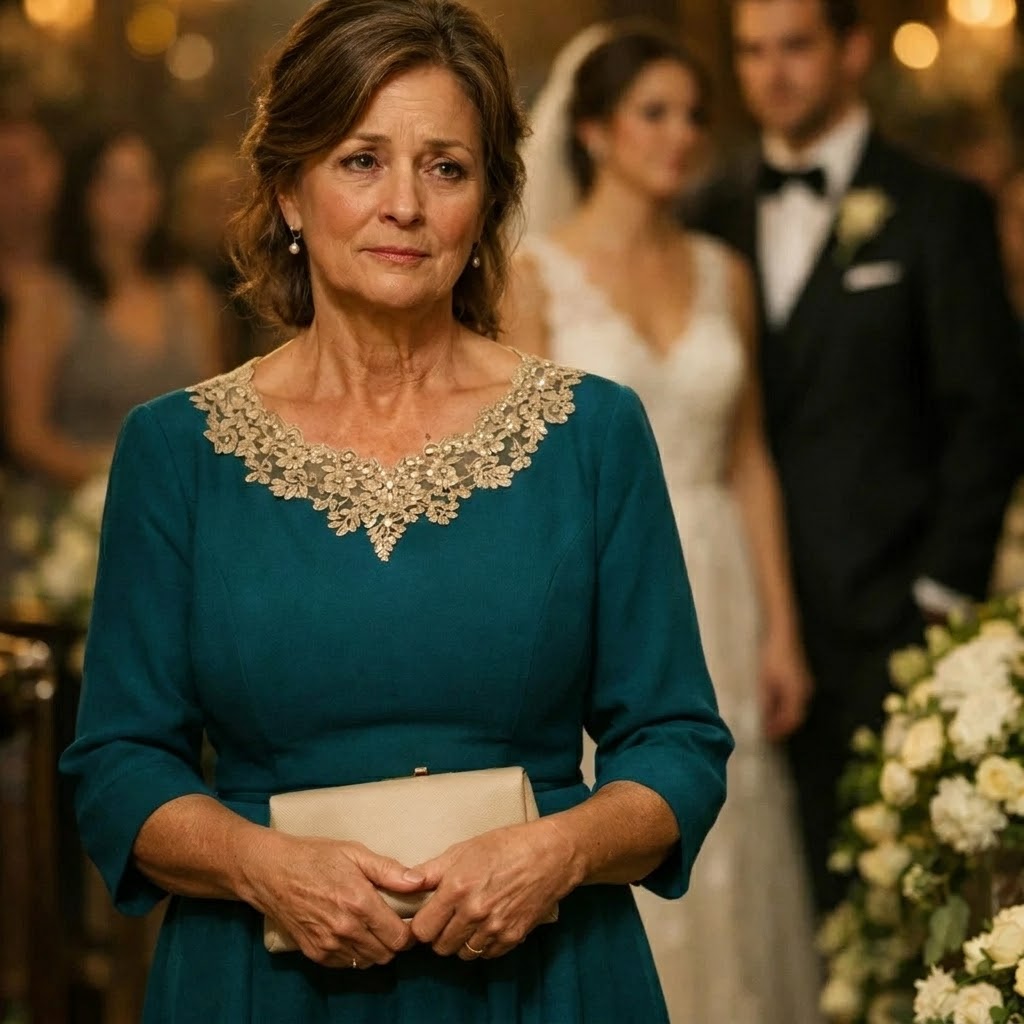
People crowd around you after that, but differently now. No longer out of pity or social obligation. The story has stripped the room down to the simplest truth, and everyone knows it. Some love is so enormous it embarrasses every shallow standard in sight. Some dignity arrives in worn fabric and callused hands. Some women walk into glittering rooms carrying nothing but an old green dress and end the night owning the moral center of the place.
Later, when the music softens and the guests begin leaving in waves of perfume and tired happiness, you step outside for air.
The night is warm. The sky is black velvet stretched over the city. The church bells have long since gone quiet, and the reception hall behind you glows through tall windows like a lantern full of movement. You can still hear laughter inside, the soft rhythm of cleanup, the tail end of a song someone refused to stop dancing to.
You stand there in your green dress and let the night settle around you.
A few minutes later, Lara joins you.
She slips off her heels and sighs with the dramatic exhaustion of a bride who has survived both ceremony and emotion. For a while, neither of you speaks. You simply stand side by side, two women at different ends of life’s long corridor, both somehow changed by the same day.
Then she turns to you.
“Were you angry at me?” she asks quietly.
You look at her.
“For what?”
“For making it public. For pulling you into the center like that.”
You think about it.
The honest answer deserves the moment.
“At first,” you say, “I was terrified.”
She winces. “That’s fair.”
“But no,” you continue. “I was not angry. I think…” You search for the words. “I think my whole life, I learned to survive by becoming smaller in rooms that wanted me to feel small. Today you refused to let me do that.”
Lara’s eyes fill again.
“You shouldn’t have had to disappear,” she whispers.
“No,” you say. “I shouldn’t have.”
She smiles then, a tired, beautiful smile stripped of bridal glamour and made better by sincerity.
“I love your son,” she says.
“I know.”
“And I love the woman who raised him.”
That nearly undoes you all over again.
You reach out and smooth a loose strand of hair behind her ear, the way you once did for Marco when he was too young to sit still for grooming. It surprises you both. For a second, there is a tiny awkwardness. Then Lara leans into the gesture so naturally that the awkwardness dissolves.
“You’ll make a good life together,” you tell her.
“We’ll try.”
“That’s all anyone can do.”
When you return inside, Marco is waiting near the doors with his suit jacket off and his tie loosened, looking as if this day has stretched his heart to twice its original size. He sees you and Lara walking back in together and something peaceful settles over his face.
In that moment, you understand something you had been too frightened to name before.
Your son is not leaving you.
He is expanding the circle.
The fear had lived quietly under your joy from the first moment he told you about Lara. Fear that marriage meant replacement. Fear that wealthy in-laws and elegant dinners and a world beyond the market would pull him so far from his beginnings that one day he would look back and see you only as the rough draft of a life he had outgrown. Mothers do not like to admit such things, even to themselves. They call it worry. They call it adjustment. They call it wanting the best.
But beneath it is often the oldest terror of all.
Will there still be a place for me when my child no longer needs me to survive?
That night, watching Marco come toward you with his hand extended, watching Lara smile beside him, watching the room make space without making you beg for it, you finally receive your answer.
Yes.
Not because your son owes you.
Not because sacrifice purchases permanent devotion.
But because the deepest love does not erase where it came from.
Years later, people will still talk about that wedding.
Some will tell it as the story of a bride who stopped the ceremony for her mother-in-law. Some will tell it as the story of the old green dress that made the whole church cry. Some will tell it as the day a rich family learned what dignity looks like when it arrives without diamonds. They will get details wrong. They will exaggerate. They will leave out the market mornings and the rent worries and the nights you cried where no one could hear. That is the way of stories once they leave the body that lived them.
But you will remember it differently.
You will remember the hard wooden pew under your hands when you wanted to disappear.
You will remember the warmth of Lara’s fingers closing around yours.
You will remember the piece of green fabric stitched into white silk, proof that your life had not merely been observed but honored. You will remember Marco walking down the aisle toward you with tears on his face. You will remember the sound a room makes when shame loses and love wins.
And perhaps most of all, you will remember this:
The dress was never the thing that made people cry.
It was what the dress had carried.
Years of before-sunrise labor.
Years of going without.
Years of loving one child so fiercely that poverty never managed to make that love look small. In the end, when everyone in that church stood and looked at you not with pity but with awe, it was not because the dress had become beautiful.
It was because they finally understood that it always had been.
Marco and Lara leave for their honeymoon two days later, but not before driving you to see the house.
It is modest exactly the way your dreams always were. Cream-colored walls. A little porch. A lemon tree in the yard that has not yet learned how to bear much fruit but promises it might, in time. The kitchen window catches morning light. The second bedroom smells faintly of fresh paint. In the back, there is space enough for potted herbs and maybe a chair where you can sit in the evenings without hearing mechanics shouting downstairs or neighbors arguing through thin walls.
You stand in the empty living room while Marco unlocks windows and Lara chatters about curtains and paint colors and whether you would like raised garden beds. Their voices blur together around the edges as you turn slowly in the center of the space.
For the first time in your adult life, a room exists that is not arranged around survival.
A room built not from necessity, but from gratitude.
You touch the wall lightly.
Then you look down at yourself.
You are still wearing the green dress.
Not because you planned to.
Not because there was nowhere else to go.
Because somehow, in the rush of gifts and signatures and tears and the exhaustion of the day after a wedding that cracked the world open, you never took it off before coming here. The old fabric hangs softly over your body, a little tired, a little too loose at the waist, a little frayed at one hem.
And suddenly you laugh.
Lara turns. “What?”
You shake your head. “Nothing.”
But it is not nothing.
It is the strange, tender humor of life.
That the very dress you thought might shame your son in front of the world became the thread that bound all of you more tightly together. That a garment worn thin by years and memory could walk into a church full of polished people and leave wearing glory. That a woman who planned to hide in the back pew would end the day in the front row, in the center of the dance floor, in the heart of a new family’s first promise.
Later, after Marco and Lara leave, you sit alone on the floor of your new living room with the folder of papers in your lap and the windows open to the afternoon.
A breeze moves through the house.
You can hear neighborhood sounds outside. A dog barking. Someone dragging a trash bin. A radio playing far away. Ordinary sounds. Beautiful sounds. The sounds of a life waiting to be lived.
You close your eyes.
And because there is no one there to perform for, no one there to reassure, no one there to protect from your feelings, you let yourself speak aloud the thing you have never said in full.
“I did it,” you whisper.
Not the wedding.
Not the dress.
Not even the house.
The life.
You did it.
Du hast deinen Sohn großgezogen. Du hast ihn durch die härtesten Jahre getragen. Du standest in Räumen, die dich kleiner fühlen lassen wollten, und du bist nicht zerbrochen. Du hast dich verbogen, ja. Du machst dir Sorgen. Du hast deine Bedürfnisse zu oft und deine Einsamkeit zu tief versteckt. Aber du bist nicht gebrochen. Und eines Tages, gegen jedes Budget, jede gesellschaftliche Regel, jeden demütigenden Blick, kehrte die Liebe in der Öffentlichkeit für dich zurück und rief dich nach deinem wahren Wert.
Draußen verändert sich das Licht.
Drinnen atmet das Haus um dich herum.
Du sitzt dort in dem alten grünen Kleid, bis die Sonne untergeht und die Wände golden werden.
Und zum ersten Mal seit sehr langer Zeit schämst du dich nicht für das, was du zum Überleben getragen hast.
Du fühlst dich genau richtig angezogen.
Die vollständige Kochanleitung finden Sie auf der nächsten Seite oder durch Klicken auf die Schaltfläche „Öffnen“ (>). Vergessen Sie nicht, den Beitrag mit Ihren Freunden auf Facebook zu teilen.